What Should the Voltage Read for Honeywell Valve Motor for Boiler
 Heating System Boiler Zone Valve Controls
How to install,wire, troubleshoot or repair a zone valve
- POST a QUESTION or COMMENT virtually zone valves on hot water heating systems: installation, diagnosis, repair advice
InspectAPedia tolerates no conflicts of involvement. We have no relationship with advertisers, products, or services discussed at this website.
Zone valves on hot water heating systems:
What is a zone valve, how practice they work.
How do I cull & install a zone valve, how practise I wire up a zone valve, and how exercise I troubleshoot, repair or supervene upon a zone valve?
This article serial answers most questions about Heating Organization Boiler Controls on fundamental heating systems to aid in troubleshooting, inspection, diagnosis, and repairs.
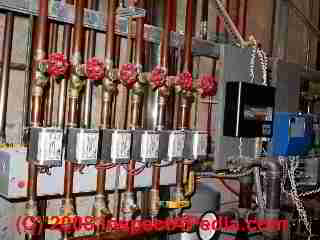
The photograph above shows a bank of six zone valves decision-making oestrus distribution in a big home.
We also provide an ARTICLE Index for this topic, or yous can try the page top or bottom SEARCH BOX as a quick fashion to find information yous need.
Explanation of Zone Valves on Heating Boilers - Decision-making Hot H2o Oestrus
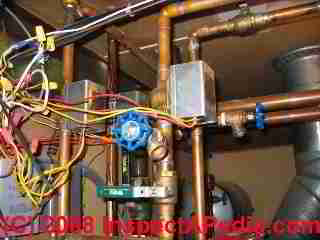 Our photo at left shows a Honeywell (TM) zone valve installation.
Heating h2o pipage in a building, especially where hot water baseboard heat is used, may be divided into separate heating zones (different floors, or different areas on a single flooring) to allow more than detailed command of heat distribution in a building.
The control of heating water through these dissimilar heating zones may be accomplished by use of zone valves (i per heating zone or area or "loop" of heating piping) which in turn are connected to individual thermostats.
Whenthe thermostat calls for heat in a detail edifice surface area, the thermostat switch causes the zone valve to open, to allow hot h2o to flow through that zone.
Other brands of zone valves such as those made by Flair (TM) (problem prone - shown below), and White Rodgers piece of work similarly merely their wiring may be slightly different. Wiring details for the yellow Flair Zone-A-Trol valve shown above are given
at ZONE VALVE MANUALS & WIRING
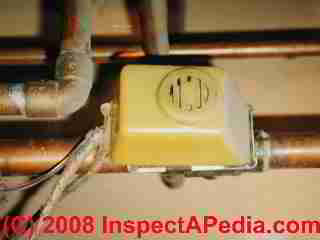
In all cases, when the zone valve is fully open, an "end switch" inside the valve tells the heating system's circulator to begin operating, causing hot h2o to flow through the zone.
Typically heating systems using zone valves will take two or more zone valves (commonly merely non always located close to the heating boiler) and a single circulator pump (commonly located on the return finish of the hot water pipage close to the heating boiler).
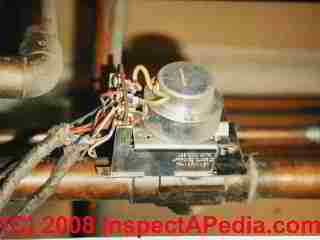
But if you run across a zone valve with the embrace off (photo at left) that may be a clue that the valve has been having issues with jamming or sticking - someone left the cover off to try to keep the valve a little cooler.
Good installation details install a zone valve on the return side of the heating pipage loop where information technology will exist exposed to lower and thus less stressful temperatures.
Zone Valve Defects Checklist
- Zone valve does not piece of work - jammed, stuck, does not open up in response to telephone call for oestrus at that zone. Provided the wiring and thermostat are right and operating, if no hot water flows past the valve on a telephone call for oestrus (feel the pipes for heat) it may be jammed and demand replacement
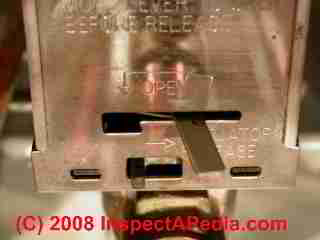
Our photo (left) shows the manual command valve in its "automatic" or normal position on a Honeywell™ heating zone control valve.
See ZONE VALVE LIFE Affected by Boiler Water Chemistry below
- Zone valves installed on the hot side or boiler-out side of the heating piping loop, exposing the valve to college and more stressful temperatures
- Zone valve installed backwards: the valve must exist installed so that the pointer on the valve body matches the direction of flow of the hot water.
See ZONE VALVE BANGING or BACKWARDS
Water hammer, discussed in general
at Water HAMMER Racket DIAGNOSE & CURE
- Zone valve with covers off - may indicate overheating and jamming
- Zone valve with its transmission lever left in the manual "on" position - may indicate that the valve does not piece of work - this zone is forced into "always on" status.
In our photo higher up, that notch at the left terminate of the zone valve command lever volition "lock" the valve in the open position. In normal, not-locked-open operation, the lever will move from left to correct in the horizontal slot as the zone valve motor opens (lever to left) or closes (lever to right) the valve.
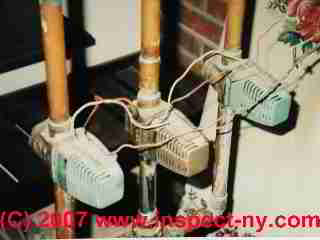
Stuck Zone Valves: Older models of some zone valves such equally these Flair™ valves are perhaps more likely to exist "stuck" either open up (you lot'll have heat in that zone) or shut (that zone won't estrus).
- Uneven zone heat distribution among multiple zone-valve controlled heating zones:
Because heating zone pipage and zone size or zone surface area heat loss may vary widely within an individual building, if we cannot regulate the hot water flow in individual zones we may find that when more than one of the thermostats are calling for heat at once, some building areas may be also common cold while others may be likewise warm.
The heating system installer or service technician addresses this oestrus imbalance by fine-tuning the volume or the rate at which heating water is delivered to different building areas.
She or he does this by installing and adjusting manual or automatic zone balancing valves or zone flow control valves of various types.
Run into CHECK VALVES, HEATING Organisation for details.
- Zone valve is leaking - leaky zone valves will stop working soon and need replacement. Example:
Norby said: (2/1/2014)
I take a zone valve dripping and when the thermostat turns on the zone valve spins and won't stop on open. It will close when the thermostat shuts off. If I disconnect the wiring and leave the zone valve open volition it only pump water thru that zone when another zone is open and making the pump run?
Answer: Norby,
When a zone valve is dripping from the solder or sweat connections it may be possible to repair it - simply that'll unremarkably require draining water out of the zone piping first. If the valve is dripping from the valve assembly or motor it'due south shot and needs replacement.
If the valve spins but doesn't open up I suspect the motor shaft is cleaved - in which case it might be possible to open the valve using the manual latch if your model has ane.
In that case if the circulator runs hot h2o will circulate. You tin know that the valve is open if hot water is felt in the pipe on the output side of the zone valve.
- Zone valves overloading their power transformer: powering too many zone valves from a single depression voltage transformer can impairment both the zone valves themselves every bit well as the transformer.
Reader Comment: details of excessive VA load on a transformer
Andre said:
Only curious nigh the query whose seven zone valves continue failing once a twelvemonth. I wonder what the rating on the transformer is? If it's a standard 40VA like you notice on a lot of equipment from the manufactory, seven of those valves will try to depict 60VA if they all open at once.The voltage volition sag, the electric current will go through the roof, and you'll burn the windings on those tiny synchronous motors. And this is not just an instantaneous brusk either - once those valves kickoff going, they keep going as long as necessary. Reader should make sure they have at least a 75VA transformer for the valves - 60VA for full load plus xx% headroom.
Respond:
Good question, Andre.
We often read about people hooking upward too many zone valves to a single transformer, overloading it. When updating this commodity I'll be sure to include your helpful comment.
Banging Heating Zone Valve: Backwards Zone Valves
Cures for Heating Boiler Water Hammer Noise at Zone Valves
Water hammer, discussed in general
at WATER HAMMER NOISE DIAGNOSE & CURE, tin occur in both edifice potable water supply systems (sinks, tubs, showers) and also in hot h2o heating systems as well as at h2o heaters or calorifiers.
At whatever h2o heating equipment, such as a heating boiler or a water heater, water hammer risks an additional take a chance too noise: h2o hammer tin crusade leaks at the temperature/force per unit area relief valve.
And over time a relief valve that leaks can too clog from mineral deposits and - to put information technology technically - crud on the valve seat. A clogged relief valve ways that the heating equipment is unsafe to operate, risking a BLEVE.
See BLEVE EXPLOSIONS for details.
If your heating system is giving a loud Bang when the zone valves open or shut (and circulator starts or stops) accept a look at the location of the zone valves.
Good practice locates the zone controls and circulators on the return side of the hydronic heating loop. At that place'south theory that the slightly lower temperatures give longer component life and that this location volition reduce water hammer noise in the heating zones.
By locating the circulator downstream from the return-side zone valves - that is, between the zone controls and the boiler, the impact of the pump start-upward on the zone valve is reduced.
If you go along to take annoying water hammer banging when the circulator pump starts (or stops) consider irresolute out your zone valves to a slow closing valve such every bit the Taco #570.
Question: what's incorrect with installing a zone valve backwards
vi Nov 2015 merlejan said:
What is the downside to installing a 4043 zone valve backwards?
Reply: problems caused by zone valves installed backwards include banging pipes and reduced valve life
Merle
A wearisome-endmost type zone valve may cause banging heating pipes if installed backwards. Here are some details:
Honeywell, for case, says the zone valve "... must exist installed so that the arrow stamped on the trunk corresponds to the flow management".
- Honeywell V8043D ZONE VALVE INSTALLATION GUIDE [PDF]
The instructions don't say why just from my reading and field experience I warn that if you hook upwardly a heating zone valve backwards, depending on several other variables including zone valve make and model and type as well every bit water velocity in that location may be problem:
- The zone valve (installed backwards) may accept trouble endmost against the force of water being pushed or pulled by the circulator pump - a probable problem since in a zone valve system typically ane circulator serves multiple zones (and zone valves)
- A flow restriction if you install the valve backwards
- Banging heating pipes and possible valve impairment when the valve closes as a consequence of load on or wear of the mechanically-operated valve gate
- Banging heating pipes when the valve is closing or airtight while some other heating zone is calling for heat (more likely with fast-closing zone valves and with zone valves on zones operating at higher force per unit area or faster water circulating rates) (Some experts opine that a White Rodgers zone valve is more than quiet-operating)
See WR zone valve manuals at WHITE RODGERS CONTROLS - all
I would non recommend modifying a bangs-at-closing zone valve by removing or weakening its closing springs every bit doing then is ultimately likely to lead to premature valve failure-to-close. I figure that the manufacturer wouldn't have put parts (springs) in the valve if they were not needed.
- If the actual valve is a "paddle valve" type closure the valve may non open and close properly and may palpitate, bang, or jam.
Mutual Sources of Banging Pipes on Hot Water Heating Systems & H2o Heaters
To be fair, non all banging noises originate at a backwards zone valve. Here are other sources of banging noises in buildings:
- APPLIANCE NOISE DIAGNOSIS
- BANGING HEATING PIPES RADIATORS
- BANGING WATER HEATER
- BANGING H2o PIPES
- WASHING Automobile Noise Crusade & CURE
At WATER HAMMER Racket DIAGNOSE & CURE we cite these other banging heating pipe sound sources
- Poorly-supported heating pipes - long loose floppy piping runs (leaks likely)
- Thermal expansion of pipes through tight building passages
Encounter Sound CONTROL for PLUMBING
- High velocity hot water circulators combined with fast-endmost zone valve models
Come across CIRCULATORS VARIABLE SPEED
- Air in the hot water heating organization
Encounter AIR-Spring HEATING SYSTEMS - habitation
- Water hammer anywhere in a hot water heating organisation or in the edifice plumbing system (besides a function of water velocity and valve closing speed.
See WATER HAMMER NOISE DIAGNOSE & CURE
v Simple Zone Valve Diagnostic Steps
- Mechanically-stuck zone valve motors. If your zone valve has a manual override lever you can test the valve to run across if it will open and close. (Our Honeywell zone valve photo above shows this mechanical lever. The Flair zone valves at left practice not take this feature).
If the valve can exist operated mechanically but does not operate in response to the thermostat we suspect that at that place is
- A bad zone valve drive motor - the valve is not mechanically stuck simply the zone motor won't operate the valve. Time for a new zone valve.
- Faulty zone valve wiring connections or thermostatic control. Watch out: different brands of zone valves may require different wiring hook-ups and a mix of zone valve brands tin lead to some head-scratching in figuring out proper wiring.
I can't give a general solution to this trouble as nosotros need to await at the wiring diagram. Simply yes, the problem tin can be solved.
- No electrical power to the zone valve unit or to the thermostat that controls it
- Air-bound hydronic heating system: if the zone valve appears to operate properly but heat never arrives in the zone it controls,
check that the system circulator pump
(CIRCULATOR PUMPS & RELAYS
is working (pump motor hums & moves, pipes become hot on both sides of the circulator inlet and outlet).
If the circulator pump is spinning and the zone valve is open,
see AIRBOUND Heat SYSTEM REPAIR by Water FEED VALVE.
While going through the detailed sequence in the performance of the heating boiler, watch for and inspect the condition of the heating boiler controls and safety devices (as required by ASHI nine.1.A.3 automatic safety controls).
Boiler Component & Heating Zone Valve Life Affected by Banality Water Chemical science
Watch out: for banality h2o chemical atmospheric condition that could contribute to zone valve failure. These include highly-corrosive water, improper pH, and water with a high oxygen content.
[The Honeywell Honeywell V8043 series zone valve is ] suitable for glycol/water mix upward to 50:50 employ in closed hydronic systems. Not for utilise with oxygenated water, beverage h2o or steam.
Use this valve in hydronic systems which Exercise Not incorporate dissolved oxygen in the system water. The dissolved oxygen, which is found in systems that have a frequent source of brand-up h2o, causes the rubber plug within the valve to deteriorate and eventually fail.- HONEYWELL V8043D ZONE VALVE INSTRUCTIONS [PDF]
Details on the risks of harm or component failure from dissolved oxygen in heating system water as well as suggestion on avoiding those hassles are now plant
at DISSOLVED OXYGEN Damage Command.
Zone Valves on Indirect-Fired Domestic Hot Water Heaters

Indirect fired hot water heaters, in some designs, utilise a heating whorl located in the bottom of the hot water tank to heat the domestic hot h2o (used for washing and bathing).
A typical design volition include a thermostat on the water heater that will crusade hot water from a physically separate heating boiler to circulate through the heating coil located in the bottom of the indirect-fired water heater.
A separate loop of piping conducts water from a nearby heating boiler, through the coil in the bottom of the indirect fired water heater tank (thus transferring heat to water in the water heater tank), and back to the heating boiler.
Sketch (left) courtesy of Carson Dunlop Associates.
The water temperature within the indirect fired h2o heater tank is sensed by a thermostatic control that causes the hot water tank'south contents to be re-heated as needed, typically by turning on a circulator pump that moves hot water from the separate heating boiler through the ringlet in the bottom of the water heater.
While typical indirect water heaters utilise a heating loop encompassing a circulator pump and check valve, some systems may use a zone valve in this piping loop that first opens to let hot water menses though the piping loop (boiler to h2o heater coil and dorsum to boiler), and second, when the valve has opened, it turns on a circulator pump to cause h2o motion.
This organisation (or a simple check valve) prevents h2o in the hot water tank from existence heated by the boiler when it is not needed (circulating by convection, for instance).
Run across INDIRECT-FIRED H2o HEATERS for details.
Number of Heating Zones: How can I determine how many heating zones I accept?
I took a look at the boiler. I meet the 5 zones going off the outbound pipage, only I merely see 2 converging back to the intake. Practice yous recall that means the zones are not all individual loops? - Lisa
Respond:
Nigh likely you have
v private room thermostats
5 private heating zones
v loops of hot water heating pipage leaving the banality (one at each zone valve)
only at some convenient locations the installer joined several of those individual zones into one of two return lines - that's why you see just two hydronic estrus (hot water) lines returning to the boiler.
You can nonetheless drain and turn off 3 of the zones but you lot'll need a plumber to notice the END of each of the loops you desire to turn off - right where it joins a common return line. There s/he will install a drain and command valve. It may be necessary to add air bleeder or air purge valves to permit draining of individual heating zones.
See AIR BLEED VALVE INSTALLATION
The risks of turning off heat completely, besides my previous alert about non getting all the water out, are that you freeze up plumbing somewhere. If the zones do NOT estrus any rooms with plumbing yous may be ok.
An alternative, and the one that I use, is to continue all 5 zones working, but gear up the thermostats for the three unused areas to a lower than usual temperature, simply loftier enough to avoid freeze-ups - say 45 °F. Yous'll salvage significantly just past dropping the thermostat ready temperature.
In an unfamiliar habitation I might try dropping the thermostat prepare temperature gradually in very common cold weather, double-checking to see just how cold the room gets. You'll desire the zones to run occasionally to protect against freezing.
Finally, for freeze protection advice for the building, meet WINTERIZE A Edifice ( a link I'll add at the Commodity INDEX the bottom of this commodity )
Heating Zone Valves: Ordinarily-Closed vs Normally-Open Designs & Applications
Reader Question: do you advise swapping out Honeywell V8043D 5080 normally-open zone valves that go along declining?
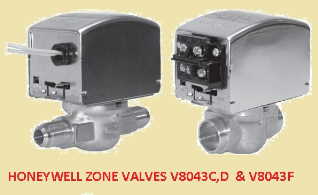
Dennis B. Hoff said: (two/3/3014)
We have a hot water boiler with 7 usually open Honeywell zone valves. They are mounted on the hot side of the boiler. We accept problems with the valve motors quitting (after nearly a year) and have to be replaced.
Would information technology be better to accept ordinarily closed valves instead of the normally open up ones? They would only require power when rut is called for and may not heat up as much. Your advice would be appreciated. Nosotros live in a area with long cold winters.
Reply:
Dennis, I don't know. I'm not enlightened of temperature-tolerance differences among the two valve descriptions y'all cite, and am confused by the query: in my limited experience a heating zone valve is opened or airtight past the room thermostat. On a call for rut the zone valve opens.
When the call for heat stops, the valve closes to cease circulating hot water.
However if you are going to the trouble of rearranging or re-sweating zone valves at a hot water heating boiler, I'd see if it were possible to put the valves on the return side of the banality - cooler water temperatures there may improve zone valve life.
If yous requite us the zone valve brand and model we tin research farther. - Daniel
Follow-up:
Zone valves we are using are a Honeywell V8043D 5080 unremarkably open (held open up past spring pressure)
When room temperature is reached the thermostat applies ability to the valve and it closes, cutting off fluid flow. In the normally closed valve the valve remains closed by leap force per unit area and opens when the thermostat apples power to it, allowing fluid menstruum.
When room temp. Is reached the thermostat cuts off power and the valve closes (by spring force per unit area) cutting off fluid catamenia.
There are also specific thermostats required for each type of valve.
The valves cannot be moved to return lines without a lot of work. I hope this helps. I exercise not accept the part number for the normally closed valve handy. - Dennis
Answer:
Cheers Dennis, indeed you are perfectly correct: the HONEYWELL V8043D zone valve [PDF installation instructions] is a "normally open up" valve while the Honeywell V8043C, F, or G models are "normally airtight". Quoting from the company's product data:
The V8043 Motorized Zone Valve provides two-position (open-close) control of supply water for baseboard radiations, convectors, fan-coil units, etc. Information technology uses a ii-wire, 24-volt control circuit and requires a SPST thermostat. Integral end-switch models permit the sequencing of auxiliary equipment. Quick Fit actuator provides easy snap on and off connection to the valve assembly.
And I agree you lot'd need to look at thermostats and wiring if changing the zone valve type as a usually-open zone valve requires a opposite-interim thermostat (as you indicated).
It is possible to simply change the actuator heads from the D model to i of the other models - changing wiring and thermostats as appropriate, leaving the actual valve trunk installed.
A thermostat wired to operate a normally-open up zone valve (NO valve) will need to exist re-wired if information technology supports operating a normally-closed (NC) valve. Otherwise the thermostat volition need replacement.
Before you lot would modify to a "normally closed" zone valve (which is more mutual at least in residential installations) we'd want to understand how your heating organisation was designed to work. The installer surely had a reason for the "usually-open up" approach.
Is this a residential building? Are in that location some special heating needs or applications?
I should add these details about the different Honeywell V8043 zone valves:
- The F and G models of this zone valve include an cease-switch to permit switching auxiliary equipment such as a water circulating pump.
- Honeywell V8043D - normally Open up (your valve) PN 4000396014 has NO Cease SWITCH - the installation presumes that the thermostat or other control is activating the circulator pump. This is the only one of the four models in this series that is a unremarkably-open zone valve.
- Honeywell V8043D - normally CLOSED PN 4000396013 has an end-switch that will be used to activate a circulator or circulator relay.
- The Honeywell V8043F has these same features. Information technology's safer to refer to the F model only I establish it listed both ways. Information technology pays to read the specs.
- Honeywell V8043C - PN 40003916011 normally closed, also has no end-switch.
Honeywell V8043G - PN 40003916012 commonly closed has as an stop-switch.,
You can obtain the installation guide and ask questions of Honeywell at 1 (877) 663 0316
And about using a commonly-open vs normally-airtight zone valve: it depends on the application; for instance some hot water applications require the valve to exist normally open up.
Some writers opine that in some buildings we install a normally-open zone command so that " ... in the consequence of power failure or malfunction the suite won't freeze and bust up the plumbing and heating pipes." - which is a bit unclear to me since in a power failure the heat is off and the circulator pump is off too - zilch is circulating. But you could argue that in the event of loss of rut but non loss of power, you lot'd gain that advantage. - Daniel
Follow-up:
What I sympathise is with the ordinarily open valve ability is required continuously keep the valve closed. I think that this could cause extra heat build upwards in the motor and cause premature failure forth with more ability usage. The normally closed valve only uses power to open the valve when heat is called for
.The application that we have is residential, but was originally installed when the house was congenital 29 years ago. It'southward a good system but we are trying to improve costs and new procedures develop with fourth dimension. There are no special heating needs or requirements.
Thanks for all of the information it will help us in making a decision. Probably one thermostats at a time. - Dennis
Reply: dissolved oxygen in heating banality water can cause zone valve failure
Dennis: thanks for the follow-upward. continue united states of america posted. Every bit I noted, unless the valve mechanism itself is damaged, y'all can only change the ability head - leaving the actual valve assembly in place. Quoting the production literature:
Easy servicing because the entire powerhead assembly can exist replaced without removing valve body from line. Optional accessory fittings can be provided to facilitate user-friendly removal of the entire zone valve unit. - op cit.
When changing the thermostat, at that place are some models that can exist wired to operate either blazon of zone valve: normally closed or unremarkably open. An example we're looking at is the Honeywell FocusPro TH6110D programmable thermostat - it'southward quite versatile.
It's non clear to me that the added rut from the 40VA transformer wiring that powers this zone valve would ordinarily be sufficient to contribute to the product'southward failure in the field. The temperatures of the circulating hot water are, in my Stance more than probable to be a factor in zone valve life.
Watch out: for conditions that could contribute to zone valve failure.
[The Honeywell Honeywell V8043 series zone valve is ] suitable for glycol/water mix up to l:l use in closed hydronic systems. Non for use with oxygenated water, potable water or steam. Use this valve in hydronic systems which Do Non comprise dissolved oxygen in the system water.
The dissolved oxygen, which is found in systems that have a frequent source of brand-up h2o, causes the rubber plug within the valve to deteriorate and eventually fail. - op cit.
Watch out: nonetheless, for wiring errors, curt circuits, or a misbehaving low voltage transformer. Those defects could contribute to zone valve failure, every bit might corrosive or mineral-laden water in more rare cases.
Encounter Chemical TREATMENTS, BOILER
Heating Zone Valve Models & Installation Instructions
Moved to ZONE VALVE MANUALS & WIRING
Reader Q&A - besides meet the FAQs series linked-to below
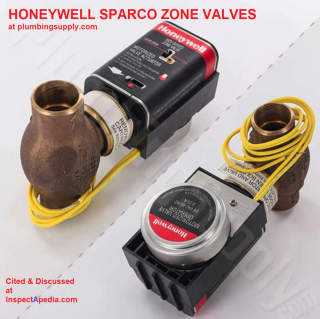 @Trevor,
Forgive the dull reply - we've been swamped with questions.
plumbingsupply.com sells replacement Sparco PowerTrack zone actuators from Honeywell.
If the failure is the actual valve and non the motor then to repair these you lot'll demand to
- cool down the heating system (plough it off and look)
- drain off pressure and water from the lines plenty that the piping in the area of work is empty (and then it can exist soldered) (open the boiler drain, using a hose to directly water to a condom drain location)
- disconnect andlabel the zone valve wiring connections - with POWER OFF
- cut out and sweat in new valves
- re-fill the heating arrangement (assuming information technology's a water-only system)
- go the air out of the heating pipes so you won't be air-bound
(Search InspectApedia.com for AIR-Bound HEATING SYSTEMS to see how we get the air out completely)
Keep me posted
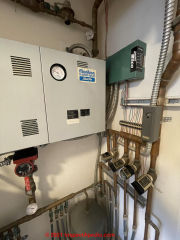
Here is another pic of the system, any insight someone could provide on changing my zone valves and the steps I need to practise to pull it off would be so appreciated!
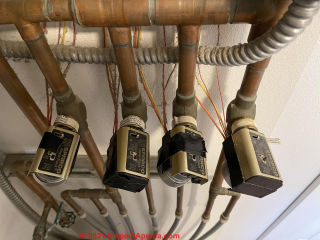
I have 4, erstwhile, Sparco PowerTrack zone actuators on my system that are literally broken into pieces. I want to supplant them with more modern zone valves (was thinking the Honeywell 3/4" Sweat valves).
I have no experience with banality systems only no how to sweat and practise copper plumbing. Can I just cutting out the one-time actuators and install the new zone valves on my own?
I understand how to wire them.
I don't know if I need to depressurize my system or drain it before I practise any of that (or how to do those things, but would dearest to save my self hundreds to thousands of dollars from doing it myself)
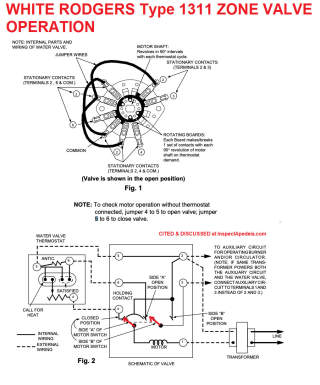 @Jon Green, Thanks for pointing out the operation of the WR-1311 Zone Valve
About the "why" of requiring electrical free energy to close the valve when the thermostat is satisfied, I'm embarrassed to pretend to second guess WR'southward engineers who certainly know more about it than yous or I, but maybe the idea was to make an inexpensive zone valve that would shut more-reliably than a spring-operated valve.
Among zone valves are models that are
NO - Normally-Open, and use a electric current to close the valve
NC - Usually-closed, and utilize a signal to open the valve
and the
WR-1311 type zone valve that uses current both to open up and to shut the valve.
This excerpt describes the operation of the White Rodgers 1311
As the When thermostat is satisfied, the valve motor is once again energized. Just afterwards the valve starts to shut, side "A" of motor switch
thermostat calls for heat, the valve motor is energized and
begins to open the valve. Soon thereafter side "A" of motor
switch makes with the holding contacts. This contact provides a
holding excursion to prevent the valve from stopping part way
through its bike if the thermostat is changed to the satisfied
position. Just earlier the valve reaches the full-open up position,
side "B" of motor switch closes (providing a low voltage auxiliary
circuit for starting burner and/or circulator). The motor stops with
the valve in the open position when side "A" of motor switch
breaks the holding contact.
(Completing a circuit through contact "6" and the thermostat anticipator.)
makes with property contact providing a holding circuit. The side
"B" of motor switch opens (breaking auxiliary circuit), and side
"A" of motor switch makes with contact "4" and so breaks the
property circuit stopping the valve in the closed position. (Fig. 2)
The contact arrangement is synthetic so that when the shaft
of the motor revolves xc° a new set up of stationary contacts makes
while the old set breaks. (Fig. 1)
For other readers, the installation instructions and wiring diagrams for this zone valve are at
WHITE RODGERS 1311 ZONE VALVE INSTRUCTIONS [PDF]
My boiler organisation has White Rogers 1311-102 Zone-A-Menses valves. These valves require thermostats to send current to the valve to turn information technology on,, simply then the valves require electric current to the opposite wires to plow the valve to the off position. Just stopping electric current to the "ON" position will do nothing as the valve stays open.
Therefore a simple 2 wire thermostat will not work without a relay to send electric current to the off wires when the thermostat turns off, or a special thermostat that sends current one way when heat is on, and current through another wire to plough the valve off.
Why would anyone desire a valve like that, instead of a spring or mechanism that but turns the valve automatically to the off position when the thermostat turns off?
@Anonymous,
I would wait get-go for a loose electrical connection and 2d I would consider replacing the zone valve actuator or motor that may be sticking or failing.
I have iii separate zone valves in my home. 1 value is for the basement apartment. At times information technology seems to be working normally; just at other times It will not phone call for heat until I plough the thermostat up for some other zone valve.
I take made the error of removing and tossing a part whose office I couldn't sympathise.
Unremarkably people don't become to the trouble of installing a valve or control unless information technology was needed.
But yep, there tin can indeed be a "left-over" control from discontinued equipment or devices.
Outset let's become estrus dorsum: for those two zone valves: try putting the valve in the MANUAL Open up position to see if that restores oestrus; that'll be diagnostic.
If the valve is open up and y'all still have no estrus in those zones and the circulator is - for certain - running, then in the Article Alphabetize see our advice on troubleshooting an AIRBOUND HEATING SYSTEM
Why add a zone valve? to have automatic control of heat in the location that the zone-valve-fed radiator(due south) or base boards enjoy.
I have a banality in an extension that provides hot water to the kitchen and extension.
The hot h2o and CH (fundamental heating) in the original business firm are provided via a 22mm feed from the boiler via a Dunsley Nutraliser to the firm radiators and bathroom hot h2o. All this works fine. All radiators take thermostatic valves to control the heat in individual rooms.
However, the 2 radiators in the extension are tapped off the 22mm feed to the main house and accept a 2 port Honeywell Motorised Zone Valve in the loop (not in the 22mm).
This seems to have stopped working as the radiators were cold even with the Thermostatic Valves fully open.
Head has been removed and valve now moves very freely using very little finger forcefulness. Checking the wiring (5 wire) against a wiring diagram the orange wire goes to a connecting block but no further. This was a professional installation not DIY.
My agreement is that the orange is normally intended every bit a feed to tell the banality to fire. Nonetheless the boiler fires fine and must exist getting signals fom other valves inside the boiler itself.
What is the point of this valve in the extension radiator loop as it just seems to become a signal to open up from the controller, take a few seconds to open and then stay open up until the developer switches it off and the spring closes it?
Seems to be an unnecessary component in the system.
Cheers
Typically the zone motor or actuator, (properly, the "zone motor assemblhy") including the White Rodgers models tin can be removed without interfering with piping
just if information technology's the valve itself I'd await to plow off water and remove pressure from the zone.
In order to change out a White Rogers Spin on or Twist On Zone Valve exercise you lot have to turn off the h2o or can you lot simply take off and twist on the new one? Thank you.
Ali
It'southward possible that in that location is air in the noisy zone, or that the zone valve actuator motor is buzzing and failing, or that a relay is buzzing;
More diagnostic suggestions are at HEATING Organization NOISE DIAGNOSIS https://inspectapedia.com/heat/Heating_Noise_Diagnosis.php
I have gas fired boiler laars mini therm jvs model and when 1 zone calls for hest boiler makes sound similar plane passing past over the house but when two zones are calling for heat banality runs fine snd the noise goes away. Do i take flow issue. Whatever advise is appreciated
Jay
Please detect your question and my detailed reply at present at the Reader Q&A section near the lesser of the article above on this folio. You may need to articulate or refresh your browser enshroud to come across the updated page. We welcome your further photos, comments, questions.
Jay,
Check to run across if the circulator is existence turned on. If non then I suspect the zone valve end switch isn't working. If that'due south the problem you'll desire to supplant the zone valve head.
Jay,
Check to see if the circulator is being turned on. If not so I suspect the zone valve end switch isn't working. If that's the problem you'll want to replace the zone valve head.
zone valve opens but boiler doesn't turn fire up on one of my zones. those baseboards merely go hot afterward when that zone cycles on afterwards another zone obviously kicked on the boiler. i call up they share the aforementioned circulator pump. is information technology the actuator or could it be air-block?
If yous're confident that the valve is opening then I doubtable that zone is are bound. Use the on Folio search box to look for our article series
on AIR-BOUND HEATING SYSTEMS to see how to diagnose and repair the trouble.
I accept a iv zone ane circulator pump hot water organisation. Three out of the iv zones are working correctly.
The one problem zone valve opens when I adjust the thermostat but the hot water only flows to the valve and a petty beyond and then the line starts cooling down and I take no heat in that expanse. Could my circulator pump exist bad although the other three zones are working?
Miriam
Indeed when your boiler (hot h2o heating system or "hydronic heating boiler") is also used to make domestic hot water (for washing and bathing) the boiler will run course time to time to keep its temperature loftier enough to produce domestic hot water.
So that's normal.
Simply IF there is heat coming out of your radiators and baseboards long after the thermostat has stopped calling for oestrus, then see
Estrus WON'T TURN OFF
I have my thermostat turned downwards lowest it tin can go merely the furnace keeps coming on, It heats hot water. The room temperature is 22 C and yet the thermostat is down all the way. Should I move the switch from auto to manual on the zone valve
Nikki
Is your boiler also making domestic hot water via tankless gyre or an indirect h2o heater? If and then that'd be a reason it even so runs from time to fourth dimension fifty-fifty if yous're not calling for heat.
The thermostat is at the lowest setting merely our oil in floor heating system nevertheless fires up hither and there (we don't want the oil in floor on since we have electrical heat pumps running). I noticed that the Manual Operating Levers on the actuators were in a one-half open position.
Is this what's causing the organisation to fire upward? Will putting the lever in a closed position cause whatever bug?
Jodeph
Thank you that's a very helpful question.
How do we know that a zone valve is working?
When the heat in the subject his own has been off for a while and the baseboards and radiators are cool plow the thermostat all the fashion up. Observe that the boiler runs and the circulator pump turns on.
When the circulator pump is running you should be able to feel the heating pipe on the inlet and Outlet side of a zone valve go from beingness cool or cold to hot. If pipe on the outlet side of the zone valve is hot so you can exist pretty sure. The heating boiler water is passing through the valve and the valve is open.
How practice yous check a zone valve to meet if it is working?
I have a Burnham v8h boiler system I removed the analog thermostats and replaced them with programmable Honeywell stats now the zone valves turn on at the correct temperature but exercise not plough off.
Steven:
Cheers for a helpful "sticking" zone valve repair question.
There are two different state of affairs:
If the zone valve failure is in the actuator motor, that's a pretty easy repair every bit the cover tin can exist removed, the motor removed, and a replacement installed without having to do whatsoever plumbing work.
The motor sits atop and operates a mechanical shaft that, by rotating, opens and closes the zone valve in response to a phone call for heat from the thermostat. Many homeowners can exercise such a repair.
But if the zone valve trouble is non the motor just the bodily valve in the valve body - the parts that rotate to either allow or not allow hot heating water to flow through the pipage, and so what's needed is to cut-out or de-solder the old valve and put in a new one; that in turn also will crave cooling downwardly the heating system and draining the zone, the re-filling the zone after the repair, and so purging air from the organization after that.
For that piece of work, the job probably goes faster and easier when washed by a trained heating service tech or plumber who is familiar with zone valve replacement.
Have a boiler with three zones, two for upstairs, one downstairs. The zone valve (Honeywell) which feeds the upstairs kitchen/dining/living/bath (large surface area) is making noise, overheating, and not opening when the thermostat calls for it to. I have to sometimes push button the lever to the correct to lock it in the open position.
I don't similar leaving information technology like that, then I put it in that location at dark when the house gets common cold, put it dorsum to normal during the day.
I'm sure it needs to be replaced. Is this a pretty easy set up for the homeowner?
I'grand accept 30 years of maintenance feel changing pumps, motors, valves, pipe systems, etc., though it is generally heavy indusrial.
I but look at this as a scaled down version of what I practice for work. Can't the module be inverse out separately instead of changing the valve? Also, tin the zones valves be installed on the return side of the banality instead of the supply side? They seem to always be very warm/hot.
Betimes:
Heating Organization Zone Valve Failure Rates, Failure Data, Honeywell vs Taco
Cheers for a helpful question on the reliability or quality of Taco vs Honeywell zone valves and actuators.
I have used, installed, and repaired both brands of zone valves since the 1970s; In the northeastern U.S. I've seen more Honeywell than Taco zone valves installed, but I have no actual zone valve failure rate information that demonstrates ane Brand is "amend" than the other.
Reading comments by diverse HVAC service techs we run across an Stance that "which is better" Honeywell or Taco turns in role on which zone valve model you're installing. I've seen some complaints most the TACO No. 271 and other complaints about the TACO 500 series and I've seen kudos and praise of the TACO ZVC series zone valves.
"Complaints" are anecdotal reports, not peer-reviewed expert research on failure rates. It'due south likely that both Taco and Honeywell have failure data for their products based on their own inquiry, on field reports, or both. But I've not found that information bachelor to the public.
Bottom line: Both Honeywell and Taco brand reliable zone valves.
But Lookout man out: wiring a MIX of the two brands on a single heating system requires some care as the two brands are not wired identically. Nosotros discuss that in this article series.
replacing boiler zone valves (have boiler serving eight condominium units), which is better: taco zone actuator or Honeywell mechanical valve?
Practiced news nearly the oestrus, Wendy;
Turned up thermostat - got heat and no more than noise. so all good. thx
if I gently push on the valve the humming changes
Wendy
It's common for the trunk of the zone valve to be hot as it's passing hot water for the heating system.
But a humming sound may mean that the valve's motor is jamming (needs replacement) OR that a nearby low voltage transformer is humming and volition need replacement presently. Come across if you can pin down the noise source precisely.
I live in a condo and the zone valve was hot to the touch on and fabricated a humming sound - is this a problem? -
I turned my thermostat right off and the valve cooled slightly to warm to touch merely still makes bustling audio -
thermostat is before long off and information technology is possible the building heat has merely been turned on for autumn -
I have no need for heat at the moment just maybe overnight - I am on the third floor -
should I consider replacing the valve or turning on the oestrus to clear the system and and then turn information technology down?
...
Continue reading at ZONE VALVE MANUALS & WIRING or select a topic from the closely-related articles below, or see the complete Article INDEX.
Or run into ZONE VALVE DIAGNOSTIC FAQs for help with diagnosing zone valve bug
Or run into these
Recommended Articles
- AIRBOUND HEAT SYSTEM REPAIR by WATER FEED VALVE if your heating zones don't get hot even though the zone valve opens, the circulator runs, and the banality heats.
- CIRCULATOR PUMPS & RELAYS
- DIAGNOSE & Fix HEATING Bug-BOILER - home
- DISSOLVED OXYGEN DAMAGE Command
- MANUALS for HEATING SYSTEM CONTROLS
- RADIATOR & ZONE CONTROL MANUALS
- THERMOSTATS, HEATING / COOLING
- ZONE CONTROLLER TACO ZVC403
- ZONE VALVES, HEATING - dwelling
- ZONE VALVE BANGING or BACKWARDS
- ZONE VALVE MANUALS & WIRING
- ZONE VALVE SIZE vs GPM
Suggested citation for this spider web page
ZONE VALVES, HEATING at InspectApedia.com - online encyclopedia of building & ecology inspection, testing, diagnosis, repair, & trouble prevention communication.
Or run into this
Index to RELATED ARTICLES: ARTICLE INDEX to HEATING SYSTEMS
Or use the SEARCH BOX constitute below to Inquire a Question or Search InspectApedia
...
Ask a Question or Search InspectApedia
Endeavour the search box but below, or if you prefer, post a question or annotate in the Comments box below and we will respond promptly.
Search the InspectApedia website
Annotation: advent of your Comment beneath may be delayed: if your comment contains an image, web link, or text that looks to the software as if it might be a spider web link, your posting will appear after it has been approved by a moderator. Apologies for the delay.
Technical Reviewers & References
Click to Show or Hide Citations & References
Publisher InspectApedia.com - Daniel Friedman
Source: https://inspectapedia.com/heat/Zone_Valve_Repairs.php
0 Response to "What Should the Voltage Read for Honeywell Valve Motor for Boiler"
Post a Comment